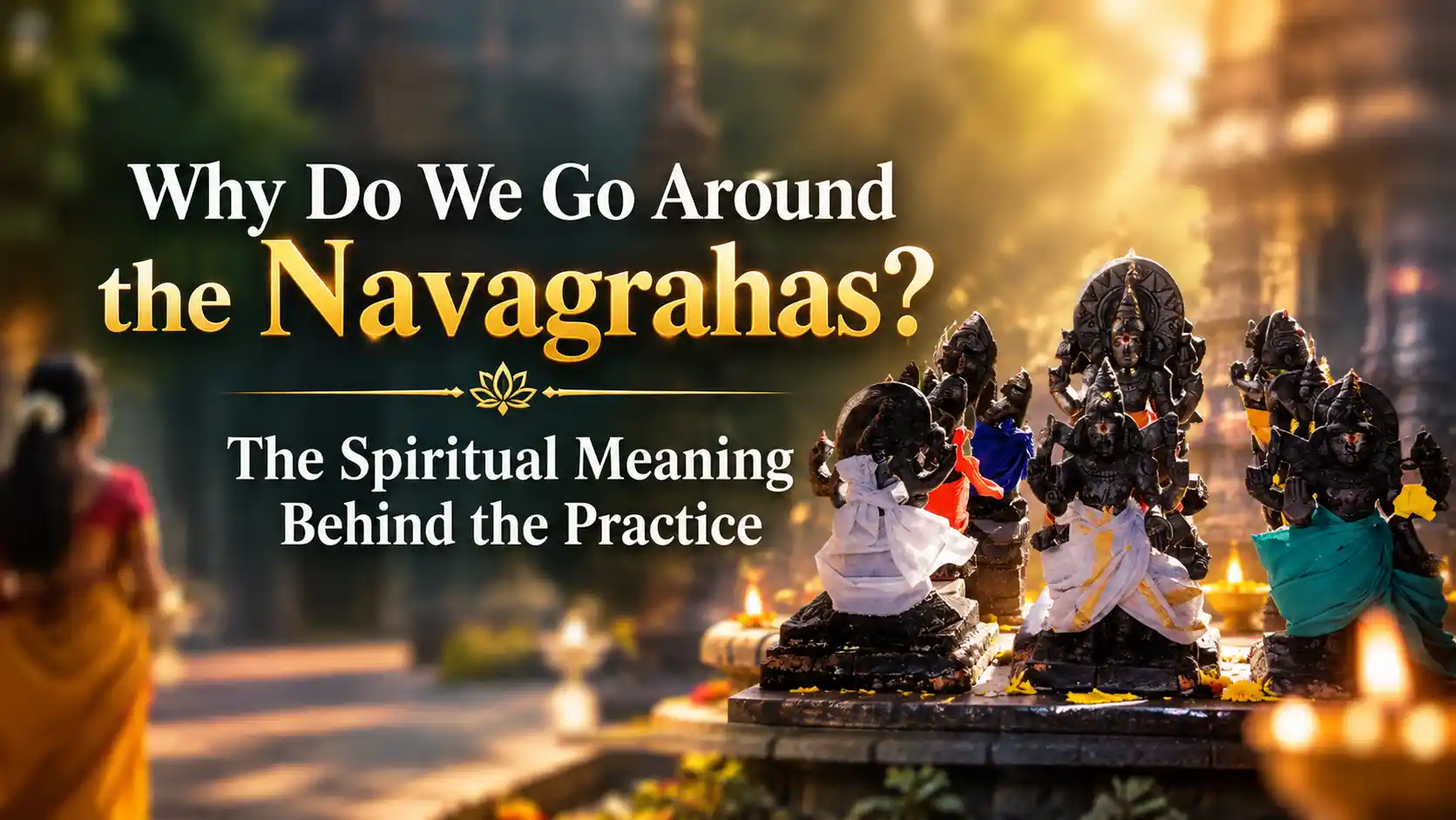
If you have visited a Hindu temple in Tamil Nadu, you have probably noticed devotees walking around the Navagraha shrine after worship. For many families, it is a familiar temple practice—something they have followed from childhood. But have you ever wondered why we go around the Navagrahas and what this practice actually means?
The answer is more meaningful than simply “going around the planets.”
The practice is connected with pradakshina, an ancient form of circumambulation in Hindu worship. Traditionally, the devotee walks around a sacred presence while keeping it on the right side. Scholars also describe pradakshina as an important part of Hindu ritual practice, particularly around temples and sacred spaces.
At the same time, Navagraha worship comes from a traditional Indian understanding of celestial influences. The nine grahas are Surya (Sun), Chandra (Moon), Mangala (Mars), Budha (Mercury), Guru (Jupiter), Shukra (Venus), Shani (Saturn), Rahu and Ketu. Rahu and Ketu are lunar nodes rather than planets in the modern astronomical sense.
What Does Navagraha Mean?
The Sanskrit word Navagraha is made up of two parts: Nava, meaning nine, and Graha, referring broadly to celestial influences or bodies.
In traditional Hindu astrology, these nine grahas are associated with different aspects of human life. This is why devotees often turn to Navagraha worship during periods they believe are astrologically significant.
Tamil Nadu is particularly known for its Navagraha temple tradition. The famous Navagraha pilgrimage circuit around the Kumbakonam region includes nine temples associated with the nine grahas. For example, Vaitheeswaran Koil is traditionally associated with Mars and is dedicated to Lord Shiva as Vaidyanathar.
But there is an important point here: Navagraha worship is a religious and astrological tradition, not a scientifically established method of changing planetary effects. The value of the practice is best understood within its spiritual, cultural and devotional context.
Why Do Devotees Walk Around the Navagrahas?
The act of walking around a deity or sacred shrine is called pradakshina or pradakshinam.
Usually, the movement is clockwise, keeping the sacred centre on the devotee’s right side. The Sanskrit term itself is associated with moving to the right. This practice is not limited to Navagraha shrines; circumambulation is also found around temple sanctums, sacred trees, hills and other sacred spaces.
So when a devotee walks around the Navagrahas, the act can be understood as a physical expression of reverence.
You are not simply walking in a circle.
You are placing the sacred at the centre and allowing your own movement to happen around it.
That is perhaps the simplest way to understand the deeper symbolism.
The Meaning Behind Clockwise Circumambulation
One of the most familiar features of pradakshina is its clockwise direction.
Traditionally, keeping the deity on the right is considered an auspicious and respectful orientation. The practice therefore turns an ordinary walk into an act of worship.
There is also a beautiful symbolic interpretation behind this.
Think about how life usually feels. We move from one responsibility to another—work, family, money, worries and plans. Everything seems to revolve around us.
During pradakshina, the idea is reversed.
For a few moments, we are not the centre. The divine is.
That simple physical movement can become a reminder to bring humility, attention and faith into our daily lives.
Is There a Specific Number of Rounds?
This is where many temple visitors have questions.
You may hear people say that devotees should go around the Navagrahas a particular number of times. However, there is no single universal rule that applies identically to every temple.
Temple traditions, local customs and instructions given by priests can differ. Some devotees may follow a particular count based on their family tradition or astrological practice.
So it is better not to assume that one number of rounds is compulsory everywhere.
If you are visiting a specific temple, following that temple’s established practice is the safest and most respectful approach.
Why Is Navagraha Worship Important in Tamil Nadu?
Navagraha worship has become deeply woven into the religious culture of Tamil Nadu.
The region’s temples often bring together mythology, architecture, astrology and everyday devotion. The Navagraha temples around the Kumbakonam area are a well-known example of this connection.
A visit to these temples is not simply about seeing nine shrines.
It becomes a pilgrimage through a cultural landscape where each temple has its own deity, story, architecture and traditional association with one of the grahas.
That is one reason these temples continue to attract devotees across generations.
What Do Devotees Pray For?
People approach Navagraha shrines with many different personal prayers.
Some may pray for peace of mind. Others may seek strength during a difficult period, family well-being, success in work, marriage-related hopes or relief from worries connected with their horoscope.
These are matters of faith and traditional belief, rather than outcomes scientifically proven to result from circumambulation.
And perhaps that distinction makes the practice easier to understand.
A temple ritual does not necessarily have to be viewed as a mechanical transaction—“I do this many times, therefore something must happen.”
For many devotees, the walk itself is a moment to pause, pray and gather their thoughts.
The Experience of Going Around the Navagrahas
There is something quietly different about walking around a Navagraha shrine.
The temple may be busy. There may be bells ringing, people talking softly and priests performing rituals nearby. Yet as you start walking, your pace naturally slows.
One round becomes another.
You look at each graha.
You say a silent prayer.
For a few minutes, the outside world feels slightly less urgent.
Whether someone approaches Navagraha worship from faith, family tradition, astrology or cultural curiosity, this is one of the most human aspects of the practice. Walking becomes a form of prayer.
That is also the broader beauty of pradakshina. The ritual uses a very simple physical action to express something much deeper: reverence, surrender and keeping the sacred at the centre.
Navagraha Worship: Faith, Tradition and Reflection
It is easy to look at temple rituals only from the outside and ask, “What benefit will I get from doing this?”
But traditional worship often asks a slightly different question:
“What does this act remind me of?”
Going around the Navagrahas can be seen as a reminder that life is larger than our immediate worries. The nine grahas represent a traditional cosmic framework, while the act of pradakshina brings the devotee into a physical relationship with that sacred symbolism.
Whether you believe deeply in astrology or simply appreciate Tamil temple traditions, the ritual offers a moment of reflection.
And sometimes, that pause is valuable in itself.
A Simple Way to Approach the Practice
If you are visiting a Navagraha shrine for the first time, you do not need to feel anxious about doing everything perfectly.
Observe the temple’s customs.
Follow the instructions given by the temple or priest.
Walk calmly and respectfully.
Take a moment at each shrine if you wish.
And most importantly, understand that the ritual is part of a living religious tradition that has been passed from one generation to another.
Final Thoughts
So, why do we go around the Navagrahas?
At one level, it is a traditional form of worship connected with the nine grahas and Hindu astrology. At another level, it is an expression of pradakshina—walking around a sacred centre while keeping it on the right.
But beyond the ritual itself, there is a simple thought worth carrying home.
When we walk around something sacred, we are symbolically saying that it deserves a central place in our lives.
For generations of devotees, that quiet walk around the Navagrahas has been more than a temple custom. It has been a small moment of prayer, reflection and faith.
And perhaps that is why the tradition continues to feel meaningful even today.