Have you ever wondered why your birth star is given so much importance in Vedic astrology?
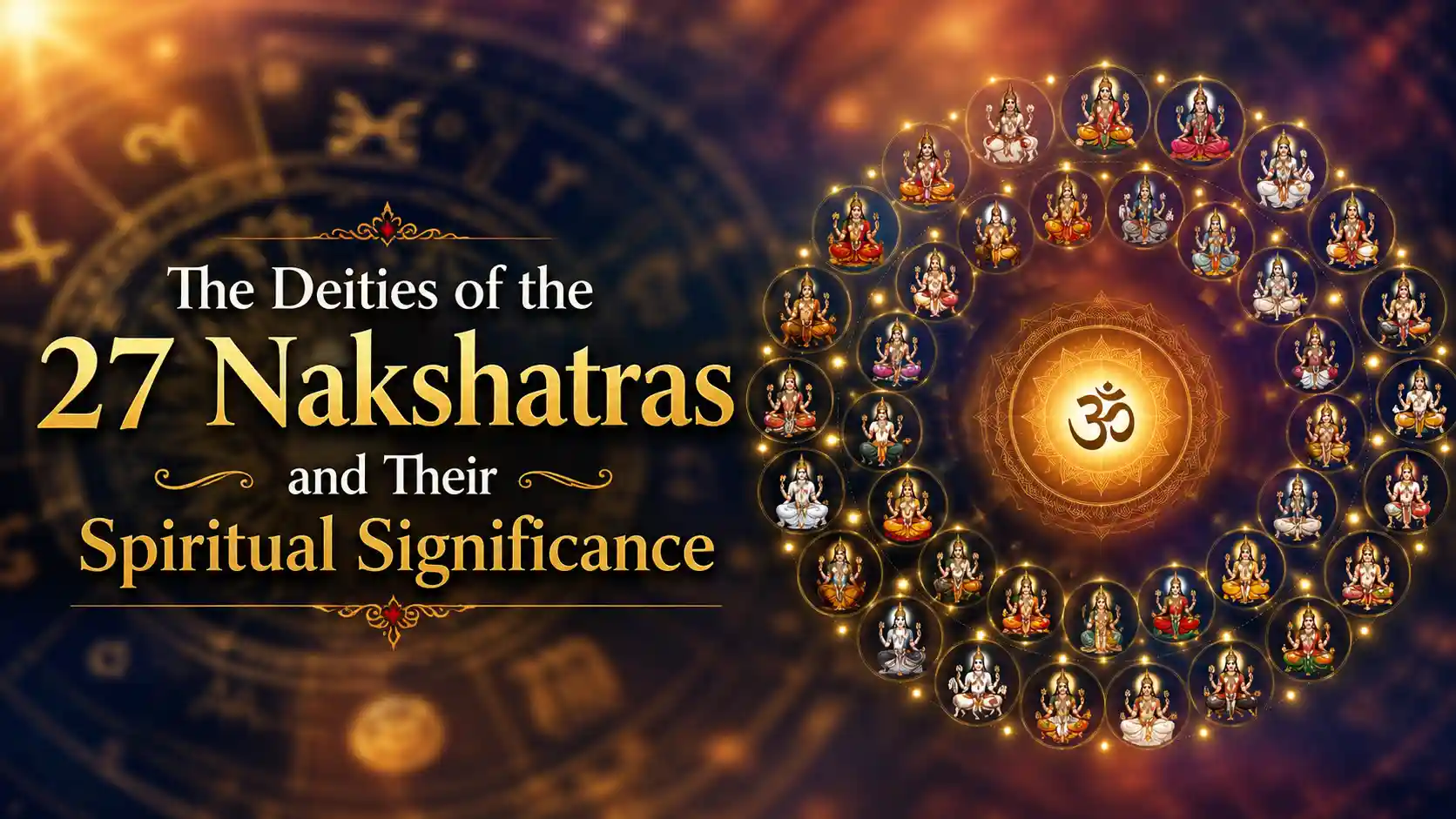
In Indian spiritual tradition, a Nakshatra is more than just a name associated with the night sky. Each of the 27 Nakshatras is traditionally connected with a particular deity, symbol, energy, and deeper spiritual quality. These connections are used in Vedic astrology to understand themes such as nature, inner tendencies, life lessons, devotion, and personal growth.
The deity associated with a Nakshatra is often seen as representing the deeper principle or energy of that star. For someone exploring spirituality, this can make the birth star a meaningful starting point for self-reflection and inner awareness.
In this article, let us explore the 27 Nakshatras, their presiding deities, and their traditional spiritual significance.
Note: The meanings below are based on traditional Vedic astrology and spiritual interpretations. They are matters of faith and tradition, not scientifically established claims about personality or destiny.
What Is a Nakshatra?
In Vedic astrology, the zodiac is traditionally divided into 27 Nakshatras, also known as lunar mansions. The Moon’s position at the time of birth is used to determine a person’s Janma Nakshatra, or birth star.
Each Nakshatra is associated with a presiding deity. These deities are not simply names attached to the stars. Within the traditional system, they represent qualities such as healing, purification, nourishment, transformation, wisdom, protection, truth, and spiritual liberation.
This is why understanding the deity behind your Nakshatra can add another layer of meaning to the study of Vedic astrology.
27 Nakshatras and Their Presiding Deities
Here is a simple overview of the traditional deity associated with each Nakshatra and its commonly understood spiritual theme.
1. Ashwini – Ashwini Kumaras
Deity: Ashwini Kumaras
Spiritual theme: Healing, renewal, speed, and new beginnings
Ashwini is the first Nakshatra. The Ashwini Kumaras are traditionally described as divine physicians. Their association gives Ashwini a strong connection with healing, vitality, restoration, and the ability to begin again.
Spiritually, Ashwini reminds us that healing is not always about going back to the past. Sometimes, it means having the courage to start a new chapter.
2. Bharani – Yama
Deity: Yama
Spiritual theme: Responsibility, transformation, discipline, and acceptance
Bharani is associated with Yama, the deity connected with dharma, death, and the natural laws of life.
Its deeper spiritual lesson can be understood through acceptance. Life involves beginnings, endings, responsibilities, and transformation. Bharani teaches the importance of carrying responsibilities with maturity and understanding that change is a natural part of existence.
3. Krittika – Agni
Deity: Agni
Spiritual theme: Purification, courage, clarity, and transformation
Agni, the sacred fire, is the presiding deity of Krittika.
Fire can destroy, but it can also purify and transform. In the spiritual sense, Krittika represents the courage to remove what is unnecessary and move toward greater clarity.
It reminds us that personal growth sometimes requires letting go of old habits, attachments, and patterns.
4. Rohini – Brahma
Deity: Brahma
Spiritual theme: Creation, beauty, fertility, growth, and manifestation
Rohini is traditionally associated with Brahma, the creator principle.
Its spiritual symbolism is connected with creation and the ability to bring ideas into visible form. Rohini reminds us that creation requires both imagination and patience.
Whether it is a relationship, a skill, a career, or a spiritual practice, meaningful growth takes time.
5. Mrigashira – Soma
Deity: Soma
Spiritual theme: Curiosity, seeking, sensitivity, and inner discovery
Mrigashira is associated with Soma, a sacred principle connected with nourishment, inspiration, and the subtle mind.
Its symbolism reflects the nature of a seeker. There is a desire to explore, question, discover, and understand what lies beyond the obvious.
Spiritually, Mrigashira encourages us to remain curious without becoming lost in endless searching.
6. Ardra – Rudra
Deity: Rudra
Spiritual theme: Transformation, emotional cleansing, truth, and renewal
Ardra is connected with Rudra, a fierce form associated with Shiva.
Ardra carries a powerful spiritual message: sometimes transformation begins when we face what we have been avoiding.
Like a storm that clears the atmosphere, difficult experiences can create an opportunity for emotional release, deeper understanding, and renewal.
7. Punarvasu – Aditi
Deity: Aditi
Spiritual theme: Renewal, abundance, freedom, and returning to light
Punarvasu is associated with Aditi, the divine mother and a symbol of vastness and nurturing.
The name itself carries the idea of returning to what is good or beginning again.
Its spiritual message is beautifully simple: setbacks do not have to be permanent. Life can offer another opportunity to rebuild, restore, and move forward with greater wisdom.
8. Pushya – Brihaspati
Deity: Brihaspati
Spiritual theme: Wisdom, nourishment, guidance, devotion, and growth
Pushya is traditionally associated with Brihaspati, the teacher and spiritual guide of the Devas.
This connection gives Pushya a strong association with knowledge, guidance, nourishment, and dharmic living.
Its spiritual lesson is that true growth does not come only from acquiring information. It also comes from applying wisdom in everyday life.
9. Ashlesha – Nagas
Deity: Nagas or divine serpents
Spiritual theme: Intuition, inner awareness, transformation, and hidden wisdom
Ashlesha is associated with the Nagas, divine serpentine beings in Hindu tradition.
The serpent is a powerful spiritual symbol. It can represent hidden energy, instinct, transformation, and deeper awareness.
Ashlesha encourages us to look beneath the surface and understand the subtle forces influencing our thoughts, emotions, and choices.
10. Magha – Pitrs
Deity: Pitrs or ancestors
Spiritual theme: Ancestral connection, tradition, dignity, and responsibility
Magha is associated with the ancestors, known as the Pitrs.
This gives the Nakshatra a strong connection with heritage, family lineage, tradition, and respect for those who came before us.
Spiritually, Magha reminds us that we inherit not only material things but also values, stories, responsibilities, and lessons from previous generations.
11. Purva Phalguni – Bhaga
Deity: Bhaga
Spiritual theme: Joy, relationships, creativity, generosity, and enjoyment
Bhaga is traditionally associated with prosperity, enjoyment, and the sharing of life’s blessings.
Purva Phalguni reminds us that spirituality does not always mean withdrawing from life. Gratitude, love, creativity, friendship, and healthy enjoyment can also become part of a meaningful spiritual journey.
12. Uttara Phalguni – Aryaman
Deity: Aryaman
Spiritual theme: Friendship, commitment, cooperation, loyalty, and social responsibility
Aryaman is traditionally connected with friendship, hospitality, alliances, and social bonds.
The spiritual message of Uttara Phalguni is about the value of dependable relationships. True connection is built through trust, responsibility, kindness, and mutual support.
13. Hasta – Savitar
Deity: Savitar
Spiritual theme: Skill, creativity, manifestation, intelligence, and purposeful action
Hasta is associated with Savitar, a solar deity connected with inspiration and creative activity.
The symbolism of the hand is especially meaningful here. Our hands allow us to create, serve, heal, build, and express ideas.
Spiritually, Hasta reminds us that intention becomes meaningful when it is translated into action.
14. Chitra – Tvashtar
Deity: Tvashtar
Spiritual theme: Creativity, beauty, craftsmanship, imagination, and transformation
Tvashtar is traditionally known as a divine craftsman.
Chitra therefore carries a strong connection with beauty, design, creativity, and the ability to transform an idea into something tangible.
Its deeper lesson is that creation becomes meaningful when beauty is combined with purpose.
15. Swati – Vayu
Deity: Vayu
Spiritual theme: Freedom, movement, independence, flexibility, and adaptability
Swati is associated with Vayu, the deity of wind.
Wind cannot be held in one place. It moves, changes direction, and finds its own path.
Spiritually, Swati represents freedom and adaptability. It encourages us to remain flexible while developing the inner strength to stand independently.
16. Vishakha – Indra and Agni
Deities: Indra and Agni
Spiritual theme: Determination, ambition, focus, transformation, and achievement
Vishakha has a unique association with both Indra and Agni.
Indra represents power and achievement, while Agni represents purification and transformative energy.
Together, they give Vishakha a strong spiritual theme of focused effort. The lesson is not simply to desire success, but to develop the discipline and clarity needed to pursue meaningful goals.
17. Anuradha – Mitra
Deity: Mitra
Spiritual theme: Friendship, devotion, loyalty, harmony, and cooperation
Mitra is traditionally associated with friendship, agreements, harmony, and trust.
Anuradha therefore carries an important spiritual lesson about relationships. Genuine devotion is not merely emotional attachment; it also involves loyalty, understanding, respect, and the ability to maintain harmony.
18. Jyeshtha – Indra
Deity: Indra
Spiritual theme: Protection, maturity, responsibility, strength, and leadership
Jyeshtha is associated with Indra, the king of the Devas.
Its spiritual symbolism is connected with seniority, protection, responsibility, and the wise use of power.
The deeper lesson is that strength becomes meaningful when it is used responsibly rather than simply displayed.
19. Mula – Nirriti
Deity: Nirriti
Spiritual theme: Root-level transformation, detachment, truth, and liberation
Mula means “root,” and its association with Nirriti gives it a powerful transformational quality.
Spiritually, Mula encourages us to look at the root of a problem rather than simply treating its surface symptoms.
Sometimes growth requires removing what is no longer serving us so that something more authentic can emerge.
20. Purva Ashadha – Apah
Deity: Apah
Spiritual theme: Purification, emotional renewal, strength, and inner cleansing
Apah represents the divine principle of water.
Water cleanses, nourishes, flows, and adapts. Purva Ashadha therefore carries spiritual themes of purification and renewal.
It reminds us that emotional healing often requires allowing feelings to move rather than holding everything inside.
21. Uttara Ashadha – Vishvedevas
Deities: Vishvedevas
Spiritual theme: Universal values, truth, righteousness, perseverance, and victory
Uttara Ashadha is associated with the Vishvedevas, a collective group of universal deities.
Its spiritual meaning is closely connected with values that are broader than individual desires: truth, integrity, responsibility, and perseverance.
The message is that lasting victory is built through consistent effort and righteous action.
22. Shravana – Vishnu
Deity: Vishnu
Spiritual theme: Listening, preservation, wisdom, learning, and spiritual awareness
Shravana is associated with Vishnu, the preserver.
The Nakshatra is also strongly connected with the act of listening. In spiritual traditions, listening is considered an important part of learning.
Sometimes wisdom does not begin with speaking. It begins with becoming quiet enough to truly listen.
23. Dhanishtha – Vasus
Deities: The Eight Vasus
Spiritual theme: Abundance, rhythm, community, generosity, and balance
Dhanishtha is associated with the eight Vasus, divine beings connected with natural and cosmic principles.
Its symbolism carries themes of rhythm, prosperity, community, and shared resources.
Spiritually, Dhanishtha reminds us that abundance becomes more meaningful when it is shared rather than possessed alone.
24. Shatabhisha – Varuna
Deity: Varuna
Spiritual theme: Healing, truth, introspection, purification, and inner freedom
Varuna is associated with cosmic order, truth, and the waters.
Shatabhisha has a strong introspective quality. Its spiritual message encourages us to face the truth within ourselves and move toward deeper healing.
The journey may sometimes feel solitary, but inner reflection can lead to greater clarity.
25. Purva Bhadrapada – Aja Ekapada
Deity: Aja Ekapada
Spiritual theme: Spiritual intensity, transformation, discipline, and awakening
Purva Bhadrapada is traditionally associated with Aja Ekapada, a mysterious and powerful divine form.
Its spiritual symbolism can be understood through intensity and inner transformation. It encourages a person to look beyond superficial desires and question what truly gives life meaning.
26. Uttara Bhadrapada – Ahir Budhnya
Deity: Ahir Budhnya
Spiritual theme: Depth, patience, compassion, stability, and spiritual wisdom
Ahir Budhnya is traditionally described as a deep cosmic serpent associated with the depths.
Uttara Bhadrapada carries themes of stillness, patience, compassion, and inner depth.
Its spiritual lesson is that not every transformation needs to be dramatic. Some of the most important changes happen quietly within us.
27. Revati – Pushan
Deity: Pushan
Spiritual theme: Protection, guidance, nourishment, safe journeys, and completion
Revati is associated with Pushan, a deity traditionally connected with guidance, nourishment, protection, and journeys.
As the final Nakshatra in the traditional sequence, Revati carries a beautiful sense of completion and transition.
Spiritually, it reminds us that every ending can also become the beginning of another journey.
Why Are Nakshatra Deities Spiritually Important?
At first, the idea of connecting a star with a deity may seem purely astrological. But when viewed from a spiritual perspective, it becomes more symbolic.
Each deity represents a quality or principle that can be contemplated.
For example:
- Ashwini Kumaras can inspire thoughts of healing.
- Agni can represent purification.
- Aditi can remind us of renewal and openness.
- Vishnu can inspire preservation and patience.
- Varuna can encourage truth and inner reflection.
- Pushan can represent guidance and protection.
In this way, the deity associated with a Nakshatra can become a point of meditation and self-reflection.
Can Your Birth Star Guide Your Spiritual Journey?
In traditional Vedic astrology, your Janma Nakshatra is considered an important part of understanding your astrological identity.
However, it is better to approach it as a spiritual framework for reflection, rather than something that rigidly determines your future.
Your birth star does not have to define who you are.
Instead, you can ask:
What quality does my Nakshatra invite me to develop?
Perhaps it is patience. Perhaps it is courage. Perhaps it is forgiveness, discipline, compassion, truth, or detachment.
This way of approaching astrology can make the subject more personal and meaningful.
A Simple Spiritual Practice Based on Your Nakshatra
If you want to connect with the spiritual meaning of your birth star, you do not necessarily need a complicated ritual.
You can simply:
- Learn about your Janma Nakshatra and its traditional deity.
- Understand the qualities associated with that deity.
- Spend a few minutes in quiet reflection.
- Offer a simple prayer according to your personal faith.
- Choose one positive quality to practice in everyday life.
- Use your Nakshatra day as an opportunity for gratitude and self-reflection.
The goal is not fear or superstition. The deeper purpose can be awareness, devotion, gratitude, and personal growth.
Final Thoughts
The 27 Nakshatras form a fascinating part of India’s rich astrological and spiritual tradition. Each Nakshatra has its own presiding deity, symbolism, and traditional meaning.
From the healing energy associated with the Ashwini Kumaras to the guidance of Pushan in Revati, these divine associations offer different ways to reflect on life.
Whether you follow Vedic astrology deeply or simply enjoy exploring spiritual traditions, the Nakshatras can offer an interesting question:
What can I learn about myself through the qualities represented by my birth star?
Perhaps that is where the real spiritual journey begins—not in predicting the future, but in understanding ourselves a little better.