Have you ever noticed that the flowers used in a pooja are not always the same?
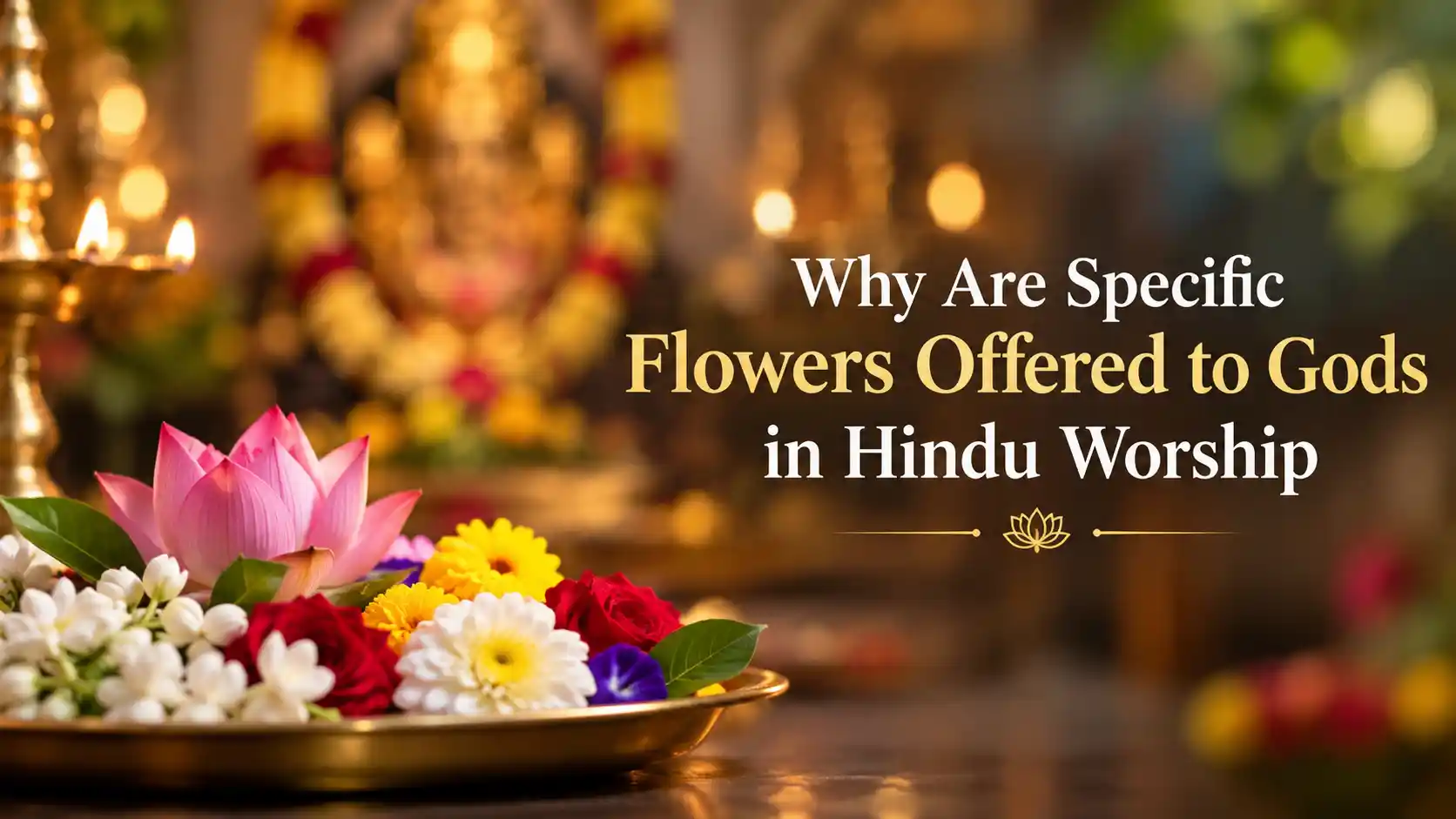
One day, you may see jasmine placed before a deity. On another occasion, devotees may bring lotus, marigold, bilva leaves or other flowers and leaves that are traditionally associated with a particular god.
It can make you wonder:
Why can’t we simply offer any flower we have at home?
For many Hindu families, there is a reason behind these traditional choices.
The practice is not simply about choosing a flower because it looks beautiful. Flowers have long been connected with purity, devotion, symbolism and tradition in Hindu worship.
And sometimes, the meaning is much simpler than we imagine.
A flower is beautiful for a short time.
We offer that beauty to God as a reminder that everything we have is temporary and should be received with gratitude.
Why Are Flowers Offered During Pooja?
Flowers are one of the most common offerings in Hindu worship.
When we take a flower in our hands and place it before a deity, it is more than just an offering of something beautiful.
It can represent our thoughts, feelings and devotion.
A fresh flower is clean, delicate and fragrant. These qualities have traditionally made flowers suitable for worship.
There is also a simple emotional connection.
When someone carefully chooses flowers, cleans them and offers them with devotion, the act itself helps the mind slow down and become focused.
That is why even a very simple pooja can feel different when flowers are part of it.
Why Does Each God Have Different Flowers?
This is where Hindu traditions become particularly interesting.
Different deities are traditionally associated with different flowers, leaves and offerings.
These associations have developed through scriptures, regional customs, temple traditions and generations of practice.
For example, the lotus is strongly associated with Goddess Lakshmi. The lotus is often seen as a symbol of beauty, purity and spiritual growth.
Similarly, certain flowers and leaves are traditionally connected with Lord Shiva, Lord Ganesha, Goddess Durga and other deities.
These traditions can vary between regions and families.
So, it is better not to think of them as one universal rule followed identically everywhere.
Instead, they are part of a rich tradition that has been passed down over generations.
Does the Flower Itself Have a Spiritual Meaning?
In many traditions, yes.
The flower is often seen as a symbol of the human mind.
Think about it.
A flower grows, blooms and eventually fades away.
In a similar way, our thoughts and emotions keep changing.
When we offer a flower to God, it can become a quiet reminder to offer our good thoughts, ego and emotions as well.
This is why you may hear elders say things like:
“Offer the flower with a pure heart.”
The flower matters, but the feeling behind the offering matters too.
Why Is the Lotus Considered Special?
The lotus is one of the most familiar flowers in Hindu spirituality.
It grows in muddy water but rises above the surface and blooms beautifully.
Because of this, the lotus has traditionally been associated with purity, spiritual growth and remaining untouched by surrounding negativity.
Goddess Lakshmi is commonly depicted seated on a lotus, and the flower has a strong place in Lakshmi worship.
The symbolism is easy to understand.
A person may live in a world filled with difficulties, distractions and challenges, yet still try to maintain a good heart and a clear mind.
That is one reason the lotus carries such a beautiful spiritual message.
What About Jasmine and Other Fragrant Flowers?
Jasmine is loved in many South Indian homes for its fragrance and beauty.
Fragrant flowers are commonly used in worship because their pleasant scent naturally creates a calm and devotional atmosphere.
In many families, jasmine is used for decorating deities, making garlands and offering during pooja.
The tradition may differ depending on the deity and local customs.
But there is something universally appealing about entering a prayer space filled with the gentle fragrance of fresh flowers.
It can immediately make the place feel peaceful.
Why Are Marigold Flowers Commonly Used?
Marigold flowers are another familiar sight in temples and homes.
They are bright, long-lasting and easily available in many parts of India.
Their vibrant colours are also associated with auspicious occasions and celebrations.
That is why marigold garlands are commonly seen during temple festivals, poojas and other religious ceremonies.
Again, the exact significance can differ depending on the tradition being followed.
Sometimes, practicality and availability also become part of how a tradition develops.
Are Leaves Also Used Instead of Flowers?
Yes.
Hindu worship is not limited to flowers.
Certain leaves are considered especially important in the worship of particular deities.
For example, bilva leaves are traditionally associated with Lord Shiva, while durva grass is commonly offered to Lord Ganesha.
Tulsi leaves also hold a special place in Vaishnava traditions and are traditionally associated with Lord Vishnu and Krishna.
These offerings are connected with long-standing religious traditions and should be understood in that context.
Is It Wrong to Offer a Different Flower?
This is something many people genuinely worry about.
The answer depends on the tradition being followed.
Certain flowers may be traditionally preferred or avoided for particular deities. These customs can come from religious texts, temple traditions or family practices.
So, if your family follows a specific tradition, it is good to respect it.
At the same time, there is no need to turn worship into a source of constant fear.
If you do not know which flower is traditionally offered, you can ask an elder, priest or follow the custom of the temple you worship at.
Devotion should bring peace, not unnecessary anxiety.
What If We Don’t Have the Traditional Flower?
This is where simplicity matters.
You may not always have access to the flower traditionally associated with a particular deity.
Maybe it is not available in your area.
Maybe it is out of season.
Maybe you simply remembered the pooja at the last minute.
That does not mean you cannot pray.
Use what is appropriate according to your family tradition and circumstances.
Even if you cannot make a flower offering, you can still light a lamp, pray sincerely and remember God with devotion.
The purpose of worship is not to make us feel guilty about what we do not have.
It is to help us remember what truly matters.
Does God Need Flowers?
This is perhaps the most beautiful question to think about.
God does not need a flower in the way we need food, water or shelter.
We are the ones who need the act of offering.
Offering a flower gives us a physical way to express something that is otherwise difficult to explain.
Gratitude.
Love.
Faith.
Humility.
Hope.
When we place a flower before God, we are also reminding ourselves to place our worries, pride and desires aside for a few moments.
That is where the deeper meaning of the offering can be found.
The Flower Is Beautiful, But the Feeling Matters More
A fresh flower may last only for a day or two.
Its fragrance fades.
Its colour changes.
Eventually, it withers.
Yet we still offer it to God.
Why?
Perhaps because the flower quietly teaches us something about life.
Beauty is temporary.
Life is temporary.
And because life is temporary, every moment of gratitude becomes valuable.
So the next time you offer a flower during pooja, don’t do it mechanically.
Take a second to look at it.
Offer it with a peaceful mind.
And think:
“May my thoughts also become as pure as this flower.”
That small thought can change the feeling of an ordinary pooja.
Final Thoughts
The tradition of offering specific flowers to Hindu gods is a beautiful combination of devotion, symbolism, family customs and spiritual practice.
Different flowers may be associated with different deities because of stories, scriptures, regional traditions and generations of worship.
But beyond all these traditions, there is a simple message.
We take something beautiful from nature and offer it with gratitude.
We pause for a moment.
We remember God.
And perhaps, while placing the flower at the feet of the deity, we also learn to offer something within ourselves.
Our anger.
Our worries.
Our ego.
Our negative thoughts.
Our gratitude.
The flower may be small, but the feeling behind it can be very deep.
So the next time you pick a flower for your pooja, don’t think of it as just another item on the prayer list.
Hold it gently.
Offer it with sincerity.
And let that little flower remind you that true worship is not only about what we place before God, but also about what we carry in our heart.