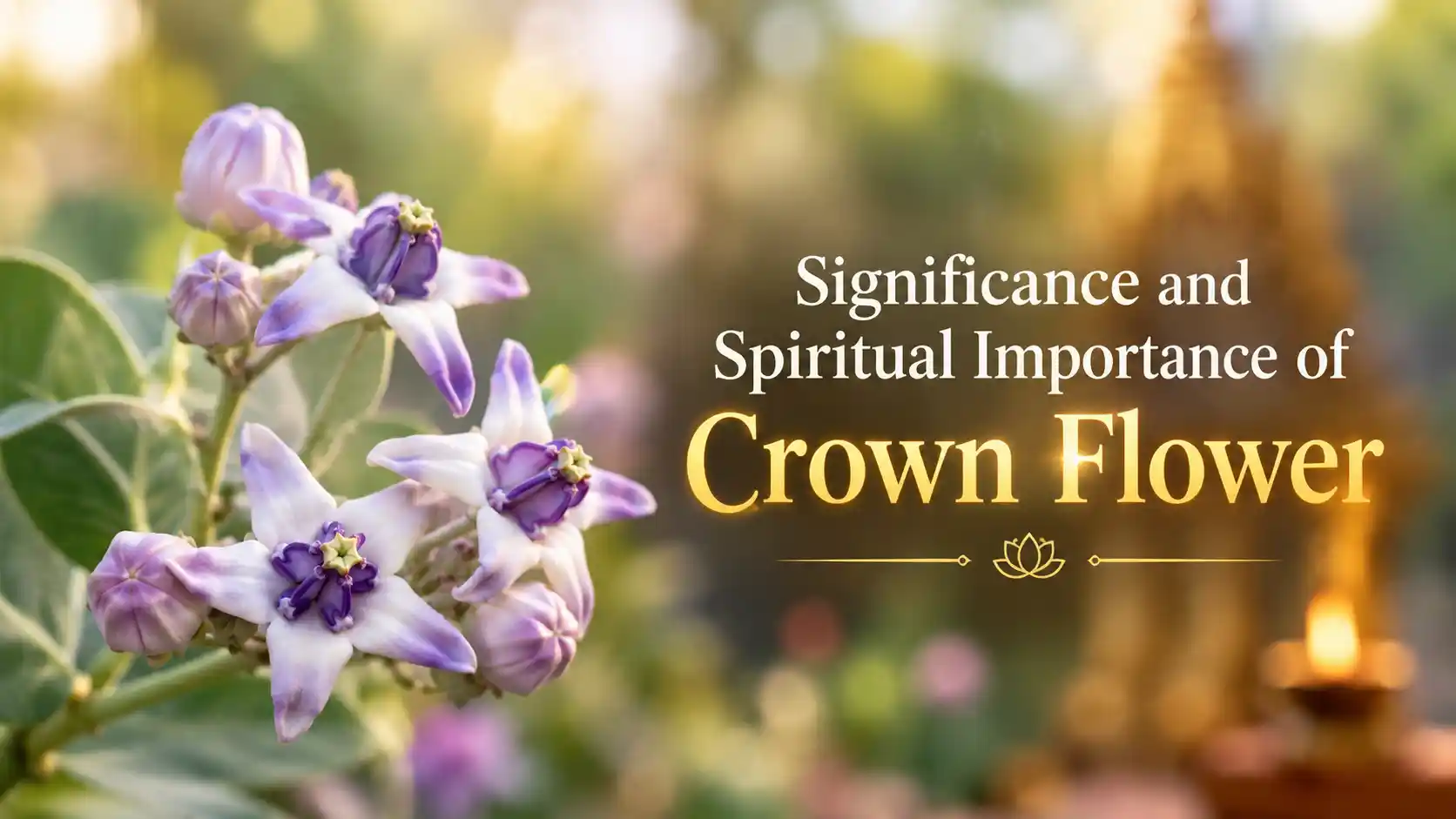
An Unassuming Flower With a Long Cultural Story
Some flowers become famous because of their fragrance. Others are celebrated for their colour or rarity. The Crown Flower belongs to a different category. It is a flower whose importance has been shaped largely by tradition, symbolism and the cultural relationship between people and plants.
In Tamil, the plant is commonly known as Erukku, and the flower is called Erukkam Poo. The name is generally associated with species from the Calotropis genus, commonly referred to in English by names such as Crown Flower or milkweed.
At first glance, the plant may not look like an obvious cultural symbol. It often grows in open land and dry environments, and many people may encounter it without giving it much attention.
Yet for generations, it has appeared in religious customs, folk knowledge and conversations about traditional plant use.
Understanding its importance requires a balanced approach. The cultural significance of the flower is one subject. Its possible biological or medicinal properties are another. And its safety is an equally important consideration.
A Flower Associated With Ganesha Worship
In several Hindu traditions, different flowers and plants are connected with particular forms of worship. The Crown Flower is among the plants that have acquired ritual significance, especially in traditions associated with Lord Ganesha.
The exact customs are not identical everywhere. India has an enormous diversity of regional practices, and a ritual common in one community may be less prominent in another.
However, the presence of Erukkam Poo in worship reveals something important about traditional ideas of sacredness.
A flower does not need to be imported, expensive or visually extravagant to have spiritual value.
The use of locally available plants reflects an older relationship between human communities and their natural surroundings. People often built religious practices using the plants that grew around them. Over time, stories, symbolism and ritual meaning became attached to particular species.
Erukkam Poo is therefore more than an offering. It is also a reminder of how closely culture once depended on local ecology.
The Connection With Shiva Traditions
The Crown Flower is also associated with certain traditions of Shiva worship. Along with other plants and flowers that appear in Shaivite practices, Erukku has a place in particular regional customs and temple traditions.
This connection reflects the diversity of Hindu worship. There is no single universal list of practices followed identically by every community. Customs have developed through local history, language, environment and devotional traditions.
Plants such as bilva leaves, datura and other species are widely associated with different aspects of Shiva worship. The Crown Flower appears within this broader cultural landscape.
From a historical perspective, such traditions are fascinating because they preserve knowledge of plants through ritual.
A person may learn to identify a plant because it is used during a festival. Another may learn its name through a family prayer tradition. In this way, cultural practices can also become informal systems for passing botanical knowledge from one generation to another.
A Plant Built for Difficult Environments
The Calotropis genus is particularly interesting because some species can grow in relatively harsh conditions.
The plants are often associated with warm and dry environments. Their ability to survive where more delicate ornamental plants may struggle is part of what makes them ecologically interesting.
The leaves are broad and distinctive, while the flowers have an unusual geometric appearance. Depending on the species and variety, the flowers may appear white, lavender or purplish.
Another characteristic feature is the milky latex released when parts of the plant are damaged.
This latex is one reason why the plant should not be handled carelessly.
Nature does not divide plants into “beautiful” and “dangerous.” A plant can have cultural value, ecological importance and chemical compounds that require caution—all at the same time.
Traditional Medicine and the Need for Evidence
Like many plants found across South Asia, Calotropis has been included in discussions of traditional medicine and folk remedies.
Historical systems of plant use have explored leaves, roots, flowers and other parts of the plant for different purposes. This history is scientifically interesting because traditional knowledge can sometimes provide clues for future research.
However, traditional use is not the same thing as proven medical treatment.
This distinction is especially important for Erukku.
The plant contains biologically active compounds, and some components can be irritating or harmful if misused. Therefore, casual advice found online—such as consuming extracts or applying preparations without understanding dosage, species identification or possible toxicity—can be risky.
A natural substance is not automatically a harmless substance.
Modern medicine requires controlled research to determine whether a particular compound is effective, what dose may be appropriate and what risks or interactions may exist.
For this reason, Erukku should not be promoted as a substitute for professional medical care.
The Flower’s Role in the Natural World
The importance of the Crown Flower extends beyond human culture.
Plants from the milkweed group can form relationships with insects and other organisms in their environment. Flowers provide ecological resources, while plant structures may support particular insect interactions.
This perspective changes the way we look at so-called wild plants.
When a plant grows without being deliberately planted in a garden, people sometimes assume it has no value. But ecosystems do not operate according to human ideas of landscaping.
A wild-growing plant can still provide habitat, participate in food relationships or contribute to the biological diversity of an area.
Of course, the ecological role of any particular Calotropis species depends on the location and ecosystem involved. Plants that are useful in one environment can also become problematic in another.
Context matters.
White and Purple Crown Flowers
In popular tradition, people may distinguish between white-flowering and purple or lavender-flowering varieties of Erukku.
These differences can become associated with particular ritual preferences or symbolic meanings. White, for example, is often culturally associated with purity and spiritual significance.
But symbolic importance should not be confused with scientific superiority.
If a particular flower colour is preferred for worship, that is a cultural or religious practice. It does not automatically mean that the same variety is medically more powerful.
This distinction may sound simple, but it is increasingly important in the age of social media, where cultural stories can quickly turn into exaggerated health claims.
Respecting tradition does not require abandoning evidence.
A Lesson About Value and Perspective
One of the most interesting lessons offered by the Crown Flower is that value depends heavily on perspective.
A gardener may consider it an unwanted plant.
A devotee may consider its flower suitable for worship.
A botanist may study its classification and reproductive structure.
A chemist may be interested in the compounds found within the plant.
An ecologist may examine its interactions with insects and the surrounding environment.
None of these perspectives completely cancels the others.
This is why culturally significant plants deserve more thoughtful discussion. They are not simply “religious objects” or “medicinal plants.” They exist at the meeting point of biology, culture and human history.
Why Safety Matters
The milky latex produced by Calotropis plants should be treated with caution. Contact may cause irritation, particularly if it reaches sensitive areas such as the eyes.
Children should also be discouraged from touching, chewing or consuming unknown parts of the plant. Pets should similarly be kept away from plant material if ingestion is possible.
If the latex accidentally enters the eye or produces significant irritation, washing the affected area and seeking appropriate medical advice is important.
These precautions do not reduce the cultural importance of the flower.
Instead, they demonstrate a more mature relationship with nature: appreciation should be accompanied by understanding.
Tradition and Science Do Not Need to Be Enemies
Discussions about traditional plants often become unnecessarily polarized.
One extreme treats every traditional practice as unquestionable truth.
The other dismisses centuries of cultural knowledge simply because it did not originate in a modern laboratory.
A better approach lies between these positions.
Traditions can preserve stories, identity and observations about the natural world. Science can investigate how plants actually function, what chemicals they contain, and whether particular uses are effective or safe.
These approaches ask different questions.
Culture may ask, “Why did this flower become sacred?”
Science may ask, “What compounds does this plant contain?”
Both questions can be worth exploring.
Conclusion
The Crown Flower, known in Tamil as Erukkam Poo, has significance far beyond its appearance.
It is connected with regional traditions of Ganesha and Shiva worship. It represents the long-standing relationship between Indian culture and locally available plants. It also has ecological and scientific interest.
At the same time, the plant reminds us that traditional knowledge should be handled responsibly. Cultural importance does not automatically make every medicinal claim true, and natural substances can still carry risks.
Perhaps the greatest significance of Erukkam Poo lies in this balance.
It teaches us that a plant can be sacred without being magical, useful without being universally safe, and culturally important without every traditional claim requiring literal scientific confirmation.
A flower growing quietly on the edge of a field may contain a much larger story—one involving faith, nature, history, science and the human tendency to search for meaning in the world around us.
The identification of Erukku with Calotropis species, its broad association with Hindu worship, and the need for caution with its milky latex are well established.
regarding specific traditional therapeutic uses because effectiveness and safety vary by preparation and require condition-specific scientific evidence.