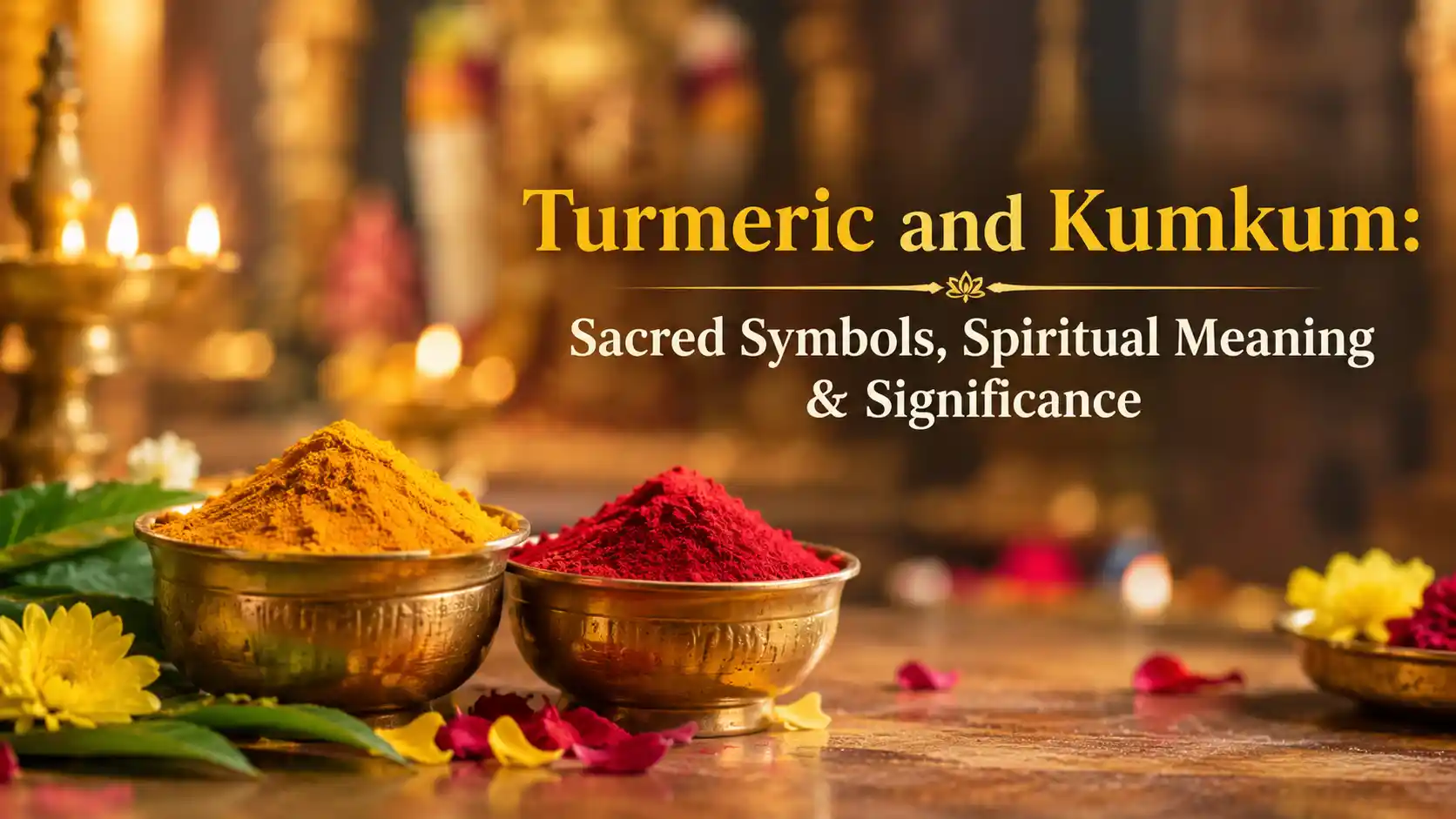
Have you ever wondered why two tiny powders—yellow turmeric and red kumkum—have such an important place in Hindu traditions? You may have seen them at a Puja, near a temple entrance, on a prayer plate, or offered to a deity.
They look simple:
- One is golden yellow.
- The other is deep red.
But behind these two colours lies a fascinating world of Bhakti, Shakti, Mangalam, and spiritual symbolism.
What if these two colours are not merely decorations… but symbols carrying centuries of tradition? Let’s uncover their beautiful story.
The Golden Secret of Turmeric
Turmeric, traditionally known as Haldi or Haridra, has a special place in many Indian customs. Its bright golden colour naturally catches the eye.
In Hindu traditions, yellow is often associated with auspiciousness, purity, prosperity, and spiritual growth. Some Hindu cultural sources also associate yellow with wonder, newness, and the Earth element.
That is why turmeric appears in many sacred occasions:
- From weddings…
- To festivals…
- To Puja and other auspicious ceremonies…
This humble ingredient often becomes part of the ritual. A simple root from the earth becomes a sacred symbol in the hands of devotion.
Why Is Turmeric Considered Auspicious?
Imagine a traditional ceremony:
- A decorated Puja Thali
- Fresh flowers
- A glowing Deepam
- And beside them, a small amount of golden turmeric
The colour itself brings a sense of Mangalam — auspiciousness. In many families, turmeric is also associated with abundance, wellbeing, and the sacredness of life.
During ceremonies, turmeric may be offered as part of the ritual or used in traditional customs. The exact practice varies between regions and communities, but the underlying idea is beautifully simple: May this occasion be filled with auspiciousness and divine grace.
And Then Comes Kumkum…
Now look at the other colour: Red. Powerful. Vibrant. Impossible to ignore. This is Kumkum.
Kumkum is commonly used as a sacred forehead marking or Tilak, and its meaning can differ according to tradition and lineage. In Shakta traditions, the red mark can symbolically represent Devi and Shakti—the Divine Feminine Power.
And suddenly, that little red dot becomes much more fascinating. It is not just a mark on the forehead—it can become a reminder of divine energy.
The Spiritual Energy of Red
Why red? In Hindu symbolism, red can be associated with Shakti, power, auspiciousness, vitality, and sacred energy.
Think of Devi—not merely as a gentle mother, but also as Durga, Kali, and the powerful manifestations of Shakti. Red therefore carries a strong symbolic presence in many devotional traditions.
It can remind the devotee:
- “There is strength within.”
- “There is divine energy within.”
- “Let my actions be guided by that strength.”
The Mysterious Forehead Mark
Here is another fascinating connection: Why is Kumkum often placed between the eyebrows?
In yogic traditions, this region is associated with the Ajna Chakra, often called the brow chakra or third eye. The Hindu American Foundation describes the bindi/tilak as being placed around this area and connects it with spiritual awareness and wisdom.
Symbolically, the mark can remind a person to look beyond ordinary distractions. Not just with the physical eyes… but with inner awareness. See the world with your eyes—but seek wisdom with your inner vision.
Turmeric & Kumkum – Why Are They Offered Together?
Now comes the beautiful combination:
$$\text{Yellow} + \text{Red} \longrightarrow \text{Turmeric} + \text{Kumkum}$$
- Auspiciousness + Shakti
- Purity + Divine Energy
In many Hindu ceremonies, both are offered as part of traditional worship. Hindu puja guides list haldi and kumkum among substances that may be offered during worship. During festivals such as Navaratri, offering turmeric and kumkum is also part of some regional traditions and social customs.
Their combination therefore becomes more than a colour contrast. It becomes a beautiful expression of reverence, blessing, and auspiciousness.
The Sacred Puja Thali
Have you ever really looked at a traditional Puja Thali? It can contain:
- Flowers
- Turmeric
- Kumkum
- Deepam
- Leaves
- Rice
- Fruits
- Other offerings
Why so many different items?
Because Hindu Puja traditionally engages multiple senses—sight, sound, fragrance, touch, and taste—to help focus the devotee’s attention on the Divine. Every object has an opportunity to become a reminder of Bhakti:
- The flower reminds us of beauty.
- The lamp reminds us of light.
- The offering reminds us of gratitude.
- And turmeric and kumkum remind us of auspiciousness and sacred symbolism.
Why Do We Offer Kumkum to Others?
This is one of the most beautiful traditions. During certain festivals and auspicious occasions, especially in some South Indian customs, women may exchange turmeric and kumkum along with other offerings.
It can become a gesture of:
- Respect
- Goodwill
- Auspicious blessings
- Connection
For many families, this is especially visible during Navaratri celebrations. A tiny pinch of kumkum, a little turmeric, and a heartfelt wish: “May auspiciousness and divine grace be with you.”
Two Colours, Two Powerful Reminders
Perhaps the most beautiful way to understand these traditions is symbolically:
- Turmeric can remind us of auspiciousness, purity, and abundance.
- Kumkum can remind us of Shakti, vitality, and divine energy.
Together, they represent a beautiful spiritual balance:
- Grace and strength
- Peace and power
- Devotion and energy
Are These Just Superstitions?
This is where we should make an important distinction.
The spiritual meanings associated with turmeric and kumkum belong to religious and cultural traditions. Their symbolism should not be confused with scientifically proven supernatural effects. Different Hindu communities also interpret these symbols differently.
So you don’t need to believe that a particular powder automatically creates a supernatural result. Instead, you can appreciate the deeper meaning: A physical symbol can help create a spiritual reminder. And sometimes, that reminder is what makes a ritual meaningful.
The Hidden Message Behind the Colours
Imagine standing before a deity.
- You see the golden turmeric.
- You see the red kumkum.
- You see the flame of the Deepam.
- You hear the Mantra.
- You smell the flowers.
For a moment, your attention moves away from everyday distractions. That is one of the purposes of ritual practice: to bring the mind into a more focused state of devotion and contemplation.
And perhaps that is the real mystery. The objects may be small… but the meaning we give them can be immense.
The Golden Yellow & Sacred Red
Turmeric comes from the earth. Kumkum becomes a sacred mark. One carries the warmth of golden yellow; the other carries the intensity of red. Together, they have travelled through generations of Puja, festivals, ceremonies, and family traditions.
They remind us that spirituality doesn’t always appear in grand forms. Sometimes…
- It is hidden in a tiny pinch of yellow.
- It is hidden in a small red dot.
- It is hidden in the intention behind a simple ritual.
A Final Thought
The next time you see turmeric and kumkum placed on a Puja Thali, don’t look at them as ordinary powders.
Pause. Look at their colours. Remember their symbolism. Think of the generations who have used them in sacred traditions.
And remember:
- Turmeric can remind us of auspiciousness.
- Kumkum can remind us of Shakti.
And both can remind us of something even deeper—spirituality is often found not only in grand temples and elaborate ceremonies… but also in the smallest symbols we carry with faith.
Two colours.
Two sacred symbols.
Countless generations of devotion.
Sometimes, the smallest rituals carry the biggest stories.