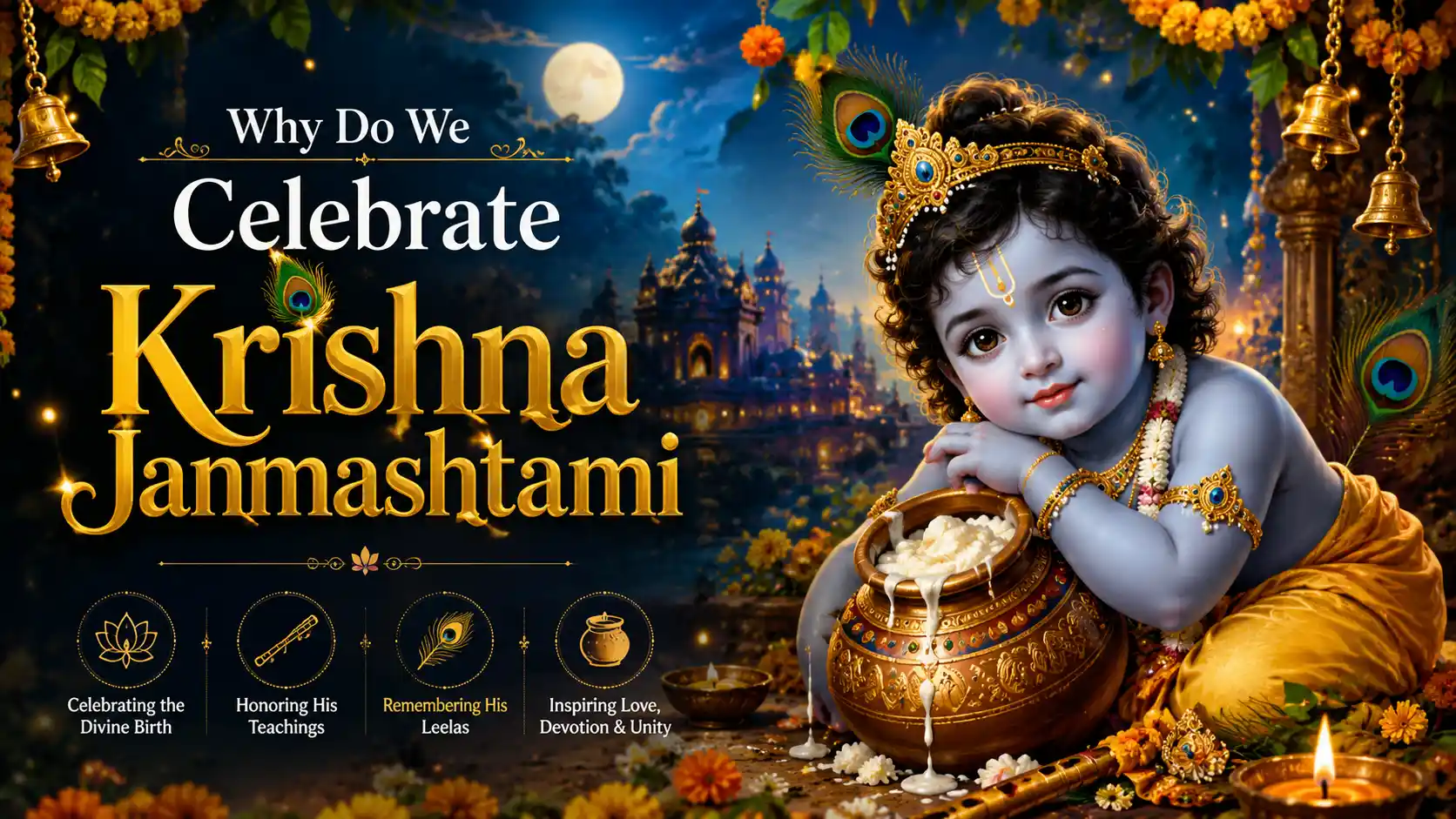
Krishna Janmashtami is often introduced as the celebration of Lord Krishna’s birth. That description is correct, but it barely captures the cultural depth of the festival. Across India, the occasion brings together mythology, devotion, family traditions, music, food, storytelling, and philosophical reflection.
For many people, Janmashtami is not simply about remembering a divine figure from the past. It is an annual opportunity to revisit certain enduring questions:
- What should a person do when power becomes unjust?
- Can hope survive during a period of fear?
- Is intelligence as important as strength?
- How can people perform their responsibilities without allowing success and failure to completely control their lives?
These questions are part of the larger cultural legacy associated with Krishna, which is one reason the festival continues to remain relevant across generations.
The Story Behind Krishna’s Birth
According to Hindu tradition, Krishna was born during a period of political oppression under King Kamsa of Mathura. A prophecy warned Kamsa that the eighth child born to his sister Devaki would eventually cause his downfall.
Consumed by fear, Kamsa imprisoned Devaki and her husband Vasudeva. The story of Krishna’s birth describes a dramatic night in which the newborn child is taken away from the prison and carried to safety across the Yamuna River. Krishna is then raised in Gokul under the care of Yashoda and Nanda.
For believers, this narrative is a sacred account. From a broader cultural perspective, it carries a powerful symbolic theme: fear may attempt to control the future, but control built on cruelty is inherently unstable. The birth of Krishna represents the arrival of possibility at a moment when hope appears almost impossible.
Why Is Krishna’s Birth Celebrated?
Janmashtami celebrates the appearance of Krishna, traditionally regarded in Hinduism as an avatar of Vishnu. Yet the emotional appeal of Krishna is partly connected to the extraordinary variety of roles associated with him.
He is remembered as:
- A playful child
- A beloved friend and musician
- A protector and strategist
- A philosophical guide
This variety allows different people to connect with Krishna in different ways. A child may enjoy stories about butter and playful adventures. A musician may connect with the image of the flute. A student of philosophy may turn toward the Bhagavad Gita. Someone facing a difficult decision may reflect on the idea of duty and responsibility. Janmashtami brings these interpretations together.
The Celebration of Childhood
One of the most visually recognizable aspects of Krishna Janmashtami is the image of baby Krishna. Homes and temples feature decorated cradles, small footprints, flowers, lamps, and offerings associated with the child Krishna.
Childhood represents innocence, curiosity, spontaneity, and joy. In adult life, these qualities are often replaced by deadlines, financial responsibilities, social expectations, and constant competition.
The stories of young Krishna offer a striking contrast to that pressure-filled existence. They remind people that life does not have to be experienced only through achievement and obligation—play, affection, laughter, and relationships also hold immense value.
How Families Celebrate Janmashtami
Celebrations differ between regions and communities across India:
| Region / Tradition | Typical Celebrations & Rituals |
| Tamil Nadu & South India | Preparing traditional snacks (seedai, murukku, aval, butter); drawing decorative baby footprints leading to the prayer area to welcome Krishna. |
| Maharashtra & Western India | High-energy public Dahi Handi events, where human pyramids break pots of butter suspended high in the air. |
| North India (Mathura & Vrindavan) | Grand midnight temple ceremonies, devotional singing (bhajans), dramatic reenactments (Raslila), and fasts. |
These differences highlight how a shared spiritual foundation can express itself through vibrant regional traditions.
Krishna and the Idea of Dharma
The philosophical importance of Krishna is strongly associated with the Bhagavad Gita, a dialogue that takes place before the Kurukshetra war in the Mahabharata.
A central theme connected with the Gita is dharma—a concept encompassing duty, responsibility, ethical order, and the appropriate course of action.
The conversation between Krishna and Arjuna becomes especially meaningful because Arjuna is not presented as an unyielding hero; he experiences conflict, doubt, and emotional paralysis. That detail remains remarkably relatable today. People frequently struggle when their choices involve family, work, loyalty, fear, or consequences. The philosophical tradition associated with Krishna encourages serious reflection about responsibility and action during these complex moments.
What Can Modern Life Learn From Janmashtami?
Modern society is very different from the world described in ancient texts, but human problems have not disappeared. People still experience anxiety, conflict, ambition, disappointment, and uncertainty. Janmashtami functions as a necessary pause in an otherwise rushed routine:
- Family Bonding: Preparing food and offerings together strengthens intergenerational relationships.
- Cultural Memory: Passing stories down to children keeps heritage alive.
- Personal Reflection: Moments of prayer or reading philosophical passages offer clarity on personal struggles.
Traditions survive when people find meaningful ways to connect them with their contemporary lives.
A Festival of Hope and Renewal
The story surrounding Krishna’s birth begins with danger and uncertainty. That starting point gives Janmashtami its most powerful symbolic message: hope does not always arrive when circumstances are comfortable.
Sometimes change begins in a period of fear, and the future takes shape when no immediate solution is visible. Whether understood spiritually or symbolically, Krishna’s birth represents the idea that darkness does not have permanent ownership over the future.
Conclusion
Krishna Janmashtami is celebrated to commemorate the birth of Krishna, but its meaning extends far beyond a historical or religious anniversary. It is a festival that brings together devotion and culture, childhood and philosophy, celebration and reflection.
For one person, Janmashtami may be a night of quiet prayer. For another, it may be the memory of homemade snacks and family gatherings. For someone else, it may be an opportunity to reflect on duty, courage, or emotional balance.
Krishna’s cultural presence contains joy, complexity, intelligence, affection, and moral depth—and every Janmashtami, those stories are brought to life once again in homes, temples, and everyday conversations.