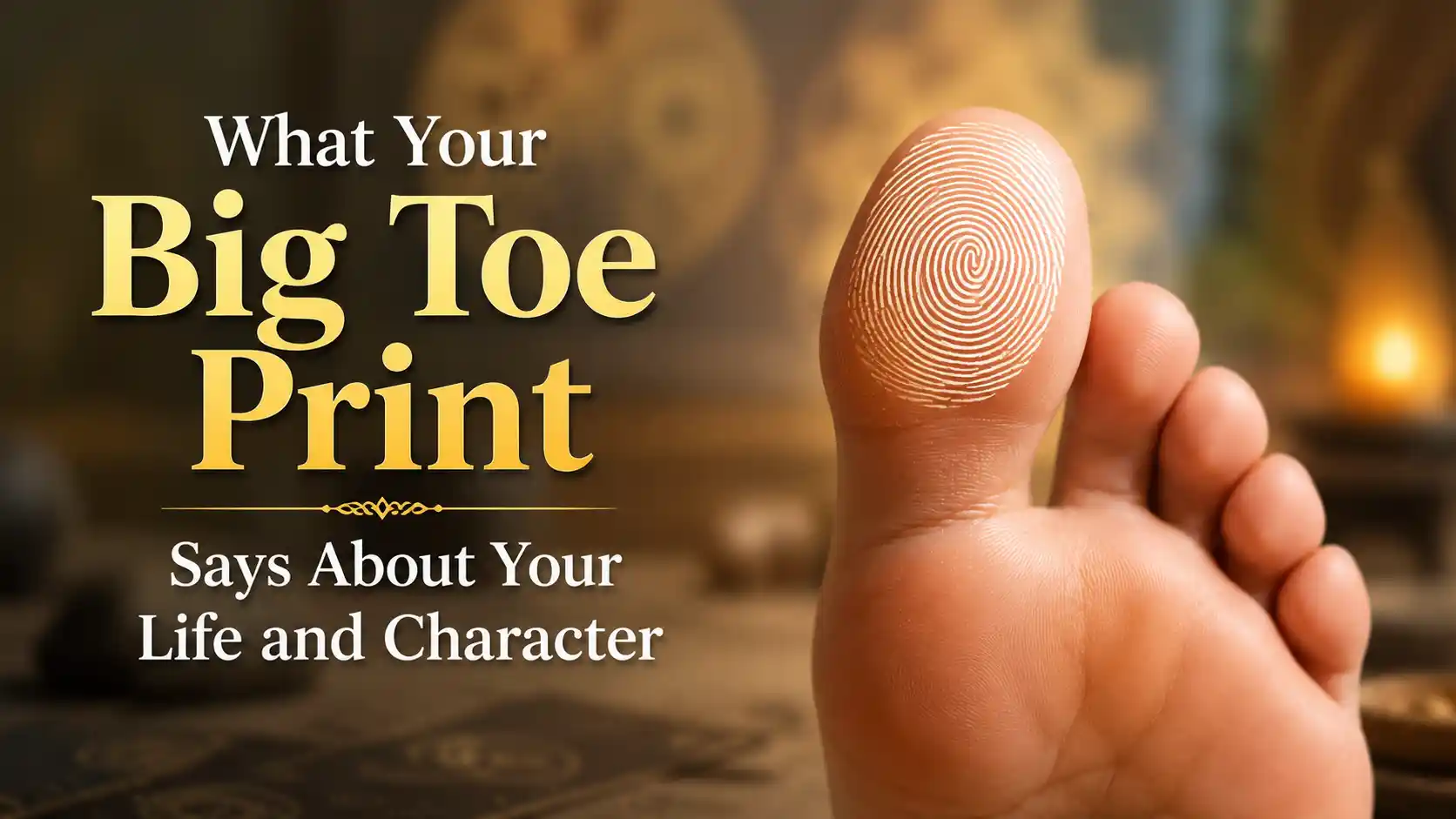
Have you ever looked closely at your big toe and noticed the unique patterns of ridges, curves, and tiny lines? Just like fingerprints, every person’s toe print is distinctive. While modern science uses these patterns primarily for identification, many traditional belief systems have long viewed them as symbols of personality, character, and life experiences.
Across different cultures, symbolic foot reading has been practiced for centuries as a way to understand human nature. Among all parts of the foot, the big toe (hallux) is often considered the most significant because it is traditionally associated with intelligence, decision-making, relationships, and personal growth.
It’s important to understand that these interpretations are cultural and symbolic rather than scientifically proven. Instead of predicting the future, they offer an interesting way to reflect on personality and life patterns.
In this guide, we’ll explore what traditional foot reading says about different big toe print patterns and the meanings often associated with them.
Why Is the Big Toe Important in Traditional Foot Reading?
In many traditional foot reading practices, the big toe represents the “thinking center” of an individual. Practitioners believe it reflects qualities such as:
- Intelligence
- Emotional balance
- Decision-making ability
- Leadership qualities
- Personal values
- Family relationships
- Life direction
Rather than focusing on one tiny detail, experienced readers usually observe the overall toe shape, print pattern, skin texture, and natural lines together.
Understanding Big Toe Prints
A toe print consists of natural skin ridges that create unique patterns. While every print is biologically unique, traditional symbolic interpretations group similar ridge formations into categories.
Below are some of the most commonly discussed symbolic patterns.
1. Circular (Whorl) Pattern
A circular or spiral-like formation is one of the most recognizable toe print patterns.
Traditional Meaning
People with this pattern are often believed to be:
- Independent thinkers
- Curious learners
- Creative problem-solvers
- Emotionally strong
- Naturally confident
Traditional readers also associate this pattern with people who enjoy exploring new ideas and making decisions independently.
2. Loop Pattern
The ridges enter from one side, curve gently, and exit on the same side.
Traditional Meaning
This is commonly linked with individuals who are:
- Friendly
- Flexible
- Patient
- Cooperative
- Family-oriented
People with loop patterns are traditionally believed to adapt well to changing situations without losing emotional balance.
3. Arch Pattern
An arch pattern flows smoothly from one side to the other without forming loops or circles.
Traditional Meaning
This pattern is often associated with:
- Practical thinking
- Honesty
- Discipline
- Reliability
- Strong work ethic
Traditional interpretations describe these individuals as dependable and grounded.
4. Composite Pattern
Some toe prints contain a mixture of loops, curves, and whorls.
Traditional Meaning
This symbolic combination often represents:
- Versatility
- Multiple talents
- Adaptability
- Leadership potential
- Balanced personality
These individuals are believed to perform well in different environments and enjoy learning new skills.
What Different Ridge Density May Symbolize
Although ridge density has no proven connection to personality, traditional readers sometimes associate it with symbolic characteristics.
Fine, Closely Packed Ridges
Traditionally linked with:
- Attention to detail
- Analytical thinking
- Careful planning
- Patience
Broad, Widely Spaced Ridges
Often associated with:
- Big-picture thinking
- Confidence
- Quick decision-making
- Adventurous nature
What the Position of the Print May Symbolize
Some traditional systems also observe how the main print appears on the toe.
Centered Print
May symbolize:
- Emotional balance
- Stability
- Clear goals
- Consistency
Slightly Off-Center Print
Traditionally associated with:
- Creative thinking
- Flexibility
- Curiosity
- Adaptability
What Tiny Natural Marks Traditionally Mean
Many people notice small natural features within the toe print.
Small Cross Lines
Traditionally interpreted as:
- Important life lessons
- Personal transformation
- Growth through challenges
Star-Like Ridge Formation
Often symbolizes:
- Recognition
- Inspiration
- Strong intuition
- Unique talents
Branching Lines
Usually associated with:
- Career changes
- New opportunities
- Personal development
- Important choices
Personality Traits Traditionally Linked to Big Toe Prints
Although interpretations vary between traditions, symbolic foot readers often connect toe prints with several personality characteristics.
Strong Decision-Makers
People with clearly defined patterns are often believed to make confident decisions while remaining focused on long-term goals.
Compassionate Individuals
Balanced ridge formations are traditionally associated with empathy, kindness, and emotional intelligence.
Creative Thinkers
Complex or unusual patterns are often interpreted as signs of imagination and originality.
Natural Leaders
Distinct, symmetrical prints are sometimes connected with responsibility, confidence, and leadership qualities.
Can Your Toe Print Predict the Future?
This is one of the biggest misconceptions surrounding traditional foot reading.
The answer is no.
Toe prints are not scientifically capable of predicting future events. Instead, traditional practitioners view them as symbolic indicators that encourage self-reflection rather than fortune-telling.
Your choices, habits, education, relationships, and experiences shape your future far more than any natural skin pattern.
Why Do People Still Explore Toe Print Reading?
Despite the lack of scientific evidence, many people continue to find symbolic foot reading meaningful because it encourages thoughtful self-examination.
It can inspire questions like:
- What are my greatest strengths?
- How do I respond to challenges?
- What qualities define my personality?
- Where can I continue to grow?
When approached with curiosity instead of certainty, toe print reading becomes an enjoyable cultural tradition rather than a prediction system.
Scientific Perspective
From a scientific standpoint, toe prints—like fingerprints—are formed during fetal development and remain largely unchanged throughout life unless affected by injury or certain medical conditions.
Researchers use these patterns primarily for:
- Personal identification
- Biometric authentication
- Forensic investigations
- Medical and genetic research
There is currently no scientific evidence linking toe print patterns to personality, destiny, intelligence, or future events.
Final Thoughts
Your big toe print is unique, just like your fingerprint. Traditional foot reading has given symbolic meaning to different toe print patterns for generations, viewing them as reflections of personality, character, and life tendencies.
Whether your print resembles a loop, whorl, arch, or a more complex combination, these interpretations should be appreciated as part of cultural heritage rather than scientific fact.
The most meaningful insight comes not from the print itself but from how it inspires you to understand your strengths, improve your weaknesses, and make thoughtful choices in everyday life.
After all, your character is shaped by your actions—not by the patterns on your feet.
Frequently Asked Questions
What does a big toe print symbolize?
In traditional foot reading, a big toe print is symbolically associated with personality, decision-making, emotional balance, and life direction. These meanings are cultural beliefs rather than scientific facts.
Is toe print reading scientifically proven?
No. Modern science recognizes toe prints for identification purposes but does not support claims that they reveal personality or predict life events.
Can toe prints change over time?
The ridge patterns themselves remain largely stable throughout life, although skin condition, aging, injuries, or certain health conditions may slightly affect their appearance.
Which big toe print pattern is considered rare?
Traditional readers often consider spiral (whorl) and composite ridge formations less common than simple loop or arch patterns.